A glass of milk with dinner. Milk in coffee or tea. A bowl of cereal in the morning, or a carton of soy milk in the fridge. Milk is part of the day for many people, and it is easy to forget it counts as food.
After a diabetes diagnosis, two questions come up often. Does milk have sugar in it? And is a plant milk, like almond or oat, a different thing for blood glucose? This article answers both, and looks at what research has found.
Milk carries carbohydrate
Milk contains lactose, a sugar that is naturally present in milk and milk products, as NIDDK describes it. Lactose is carbohydrate, so a glass of milk counts toward the carbohydrate in a meal, even when nothing has been added to it.
Here is a cup of whole milk and a cup of fat-free (skim) milk, as USDA FoodData Central measures them:
- No photo yet 11 g carbs 0.0 g fiber Milk, whole Per 1 cup
- No photo yet 12 g carbs 0.0 g fiber Milk, fat free (skim) Per 1 cup
Two things show on the cards:
- There is no fiber in cow's milk, so the carbohydrate and the sugars lines are almost the same. Nearly all the carbohydrate is the milk's own sugar.
- Whole and skim are close in carbohydrate. Taking fat out changes the fat and the energy (kcal), not the carbohydrate. Skim milk is not lower in carbs.
For carb counting, milk is counted like any other carbohydrate food, by the amount you drink. If carb counting is new to you, What is a carb choice? explains how. Flavored milks have their own records on the site; check their cards rather than the plain milk's.
Plant milks are not all alike
"Plant milk" covers many different drinks. Some are made with added sugar and some are not. A review by Vanga and Raghavan (2018) compared the four most widely drunk plant milks with cow's milk and noted that people tend to treat them as a direct substitute for cow's milk, which "might not be true in all cases".
For carbohydrate, the difference can be large. Here is unsweetened and sweetened almond milk:
-
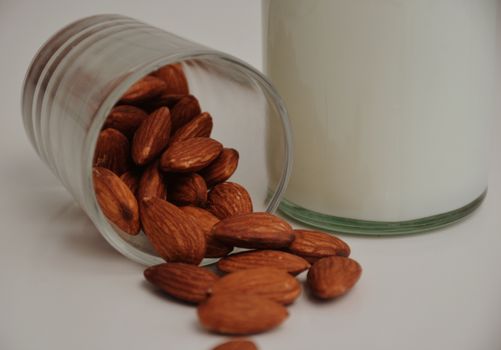 0.8 g carbs
0.0 g fiber
Almond milk, unsweetened
Per 1 cup
0.8 g carbs
0.0 g fiber
Almond milk, unsweetened
Per 1 cup
- No photo yet 11 g carbs 0.0 g fiber Almond milk, sweetened Per 1 cup
And unsweetened soy milk next to oat milk:
- No photo yet 3.1 g carbs 0.0 g fiber Soy milk, unsweetened Per 1 cup
- No photo yet 13 g carbs 1.2 g fiber Oat milk Per 1 cup
Comparing all six cards:
- Unsweetened almond and unsweetened soy milk carry much less carbohydrate than cow's milk.
- Sweetened almond milk carries several times more carbohydrate than unsweetened, almost all of it sugar.
- Oat milk carries carbohydrate in a similar range to cow's milk, though less of it shows as sugars.
Brands differ, and recipes change. The carton's own label is the most accurate source for the one in your fridge. Our article on reading nutrition labels for carbs shows where to look. Plant milks also differ from cow's milk in protein, calcium and vitamins, depending on the product. The protein row on each food page shows one of these differences.
What research says
Dairy and the risk of type 2 diabetes. Gijsbers and colleagues (2016) pooled 22 long-term studies of over 579,000 people. Total dairy was linked with a slightly lower risk of type 2 diabetes, and yogurt most clearly. Milk on its own was not linked with risk either way. These are observational studies, and they looked at preventing diabetes, not managing it. For yogurt, see Yogurt and diabetes.
Soy milk in place of cow's milk. Erlich and colleagues (2024) pooled 17 trials, in 504 adults, that swapped soy milk for cow's milk. The swap did not worsen blood glucose markers, and it lowered LDL cholesterol and blood pressure. Sweetened and unsweetened soy milk gave similar results in these trials. The participants had a mix of health conditions, not only diabetes, and several authors reported funding or employment linked to the soy industry.
Neither line of research shows that one kind of milk is right for everyone with diabetes.
What guidelines say
The American Diabetes Association's Standards of Care list "dairy (milk and yogurt) or fortified nondairy alternatives" among the nutrient-dense carbohydrate sources for people with diabetes. Their eating-pattern recommendation includes low-fat dairy or nondairy alternatives. They also recommend replacing sugar-sweetened drinks with water or low-calorie or no-calorie drinks.
NIDDK lists low-fat or non-fat milk among drinks with little or no added sugar, alongside water and unsweetened tea and coffee. If you take milk in coffee, see Coffee and diabetes; for sweetened drinks, see Sugary drinks and diabetes.
If you switch milks
Moving from cow's milk to an unsweetened plant milk can lower the carbohydrate in a meal. Moving to a sweetened one can raise it. If you take insulin or a medicine that can cause low blood glucose, a change in carbohydrate can change the dose you need, so talk to your diabetes team first. The Today page adds up what you log, including milk in drinks.
If you also have kidney disease, your team may give different advice on dairy and plant milks. The rows tagged "Kidney" on each food page show their potassium and phosphorus.
Your numbers are yours
How much carbohydrate fits your meals depends on your medicines, your glucose goals and your body. Your doctor, diabetes educator or dietitian sets those numbers, and their advice comes before anything you read here. If milk, or a plant milk, is part of your day, tell them which one and how much. They can help you count it in your plan.
Sources
- Vanga SK, Raghavan V. How well do plant based alternatives fare nutritionally compared to cow's milk? Journal of Food Science and Technology, 2018; 55(1): 10–20. pubmed.ncbi.nlm.nih.gov/29358791 (checked 8 October 2026)
- Gijsbers L, Ding EL, Malik VS, et al. Consumption of dairy foods and diabetes incidence: a dose-response meta-analysis of observational studies. American Journal of Clinical Nutrition, 2016; 103(4): 1111–1124. pubmed.ncbi.nlm.nih.gov/26912494 (checked 8 October 2026)
- Erlich MN, Ghidanac D, Blanco Mejia S, et al. A systematic review and meta-analysis of randomized trials of substituting soymilk for cow's milk and intermediate cardiometabolic outcomes: understanding the impact of dairy alternatives in the transition to plant-based diets on cardiometabolic health. BMC Medicine, 2024; 22(1): 336. pubmed.ncbi.nlm.nih.gov/39169353 (checked 8 October 2026)
- American Diabetes Association Professional Practice Committee. 5. Facilitating Positive Health Behaviors and Well-being to Improve Health Outcomes: Standards of Care in Diabetes—2026. Diabetes Care, 2026; 49(Suppl 1): S89–S131 (Carbohydrates section, recommendations 5.14 and 5.25). pmc.ncbi.nlm.nih.gov/articles/PMC12690188 (checked 8 October 2026)
- NIDDK. Healthy Living with Diabetes (last reviewed October 2023). niddk.nih.gov (checked 8 October 2026)
- NIDDK. Definition & Facts for Lactose Intolerance (last reviewed February 2018). niddk.nih.gov (checked 8 October 2026)
- USDA FoodData Central: Milk, whole (FNDDS 2705385); Milk, fat free (skim) (FNDDS 2705388); Almond milk, unsweetened (FNDDS 2705409); Almond milk, sweetened (FNDDS 2705407); Soy milk, unsweetened (FNDDS 2705405); Oat milk (FNDDS 2705412). fdc.nal.usda.gov (checked 8 October 2026)
- Food figures on this page: USDA FoodData Central, via the DiabeticIndex food database.
This article is general information, not medical advice. Talk to your diabetes care team before changing how you eat or how you take your medicines.