You may have heard that sweet potatoes are the "better" potato for diabetes. Maybe a friend swapped her baked potato for a sweet one after her diagnosis. Maybe sweet potato is already part of your family's cooking, roasted, boiled, mashed or in a stew.
So is a sweet potato really different for blood glucose? The honest answer is: less than many people think. This article goes through what a sweet potato holds, what the research says, and where the gaps are.
A sweet potato is a starchy vegetable
NIDDK, part of the US National Institutes of Health, groups potatoes and corn among the "starchy vegetables" that have more carbohydrate than other foods. Sweet potatoes belong in the same group. In the plate method, they sit in the quarter of the plate kept for carbohydrate foods, not in the half kept for nonstarchy vegetables like greens, peppers or green beans.
That does not make them a problem food. It means a sweet potato counts toward the carbohydrate in your meal, just as rice, bread or a white potato would.
Sweet potato and white potato, side by side
Here is a medium baked sweet potato and a medium baked white potato, as USDA FoodData Central measures them:
- No photo yet 27 g carbs 4.7 g fiber Sweet potato, baked, no added fat Per 1 medium
-
 60 g carbs
6.3 g fiber
Potato, baked, peel eaten
Per 1 medium
60 g carbs
6.3 g fiber
Potato, baked, peel eaten
Per 1 medium
Three things are worth noticing when you compare the cards:
- The "medium" sizes are not the same. USDA's medium sweet potato weighs much less than its medium baked potato. Part of the difference you see is simply size.
- Gram for gram, the carbohydrate is close. If you set both cards to the same weight on their food pages, the totals come out near each other.
- More of a sweet potato's carbohydrate is sugar. The sugars line on the sweet potato card is higher. That is the natural sweetness you taste. The white potato's carbohydrate is mostly starch. Both count as carbohydrate.
The fiber lines are worth a look too. If fiber is new to you, our article on fiber and diabetes explains why it matters. If you are comparing with white potatoes, see potatoes and diabetes.
How you cook it may change the rise, not the carbs
One study from Jamaica looked at sweet potatoes cooked in different ways. Bahado-Singh and colleagues (2011) tested ten local varieties, boiled, baked, roasted or fried, in ten healthy young adults. Boiled sweet potatoes had a much lower glycemic index than baked or roasted ones.
The glycemic index describes how quickly a food raises blood glucose compared with pure glucose. It does not change how much carbohydrate is in the food. You can see this on the cards below: boiled and baked sweet potato show the same carbohydrate at the same weight.
-
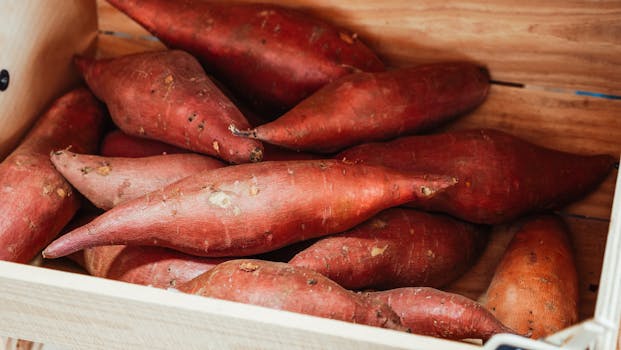 27 g carbs
4.7 g fiber
Sweet potato, boiled, no added fat
Per 1 medium
27 g carbs
4.7 g fiber
Sweet potato, boiled, no added fat
Per 1 medium
- No photo yet 17 g carbs 1.0 g fiber Sweet potato, candied Per 1 piece
The study was small, used people without diabetes, and tested Jamaican varieties that may differ from the ones in your store. It is an interesting lead, not a rule. Whether boiled sweet potato changes your own readings is something only your meter or sensor can show.
Candied, fried and sweetened versions
The second card above is candied sweet potato, the kind often served at holiday meals. Gram for gram, it carries more carbohydrate than plain sweet potato, and much more of it as sugar, because sugar or syrup is added in cooking. Sweet potato fries, chips and pies also add fat, sugar or both.
So "sweet potato" on a menu can mean very different things. The plain vegetable and the candied dish are not the same food for carb counting.
What about sweet potato as a treatment?
You may see sweet potato described online as something that lowers blood glucose. Most of that comes from studies of extracts, not of the vegetable on your plate.
A Cochrane review by Ooi and Loke (2013) looked for randomised trials of sweet potato in type 2 diabetes. It found only three, with 140 people in all, all from the same researcher. The trials tested a sweet potato preparation taken as a supplement, not cooked sweet potato. The authors judged the risk of bias unclear or high and concluded there is "insufficient evidence" about sweet potato for type 2 diabetes.
So there is no good evidence that eating sweet potatoes treats diabetes. They are a vegetable with carbohydrate, fiber and other nutrients, and they fit in a meal the same way other starchy foods do.
Where sweet potatoes fit in a meal
The American Diabetes Association's Standards of Care emphasise "minimally processed, nutrient-dense, high-fiber sources of carbohydrate". A plain sweet potato, with its skin, cooked without added sugar, fits that description. So does a plain white potato, a bowl of beans or a serving of whole grains.
What usually matters most is the portion and what else is on the plate. A sweet potato next to a large serving of rice and bread adds up quickly. Counted as the main carbohydrate of the meal, with vegetables and protein beside it, it is easier to fit. If "carb choices" is a new idea, What is a carb choice? explains how a medium sweet potato counts. The Today page adds up what you log, so you can see where it sits in your day.
If you take insulin or a medicine that can cause low blood glucose, changes to the carbohydrate in a meal can change how much medicine you need. A switch from a large white potato to a small sweet potato, for example, may mean less carbohydrate than your dose expects. Talk to your diabetes team before making that kind of change.
Your numbers are yours
How much carbohydrate suits your meals depends on your medicines, your glucose goals and your body. Your doctor, diabetes educator or dietitian sets those numbers, and their advice comes before anything you read here. If sweet potatoes are a regular part of how you or your family eat, tell them. They can help you fit them in, in the amounts that work for you.
Sources
- Bahado-Singh PS, Riley CK, Wheatley AO, et al. Relationship between Processing Method and the Glycemic Indices of Ten Sweet Potato (Ipomoea batatas) Cultivars Commonly Consumed in Jamaica. Journal of Nutrition and Metabolism, 2011; 2011: 584832. pubmed.ncbi.nlm.nih.gov/22132322 (checked 8 October 2026)
- Ooi CP, Loke SC. Sweet potato for type 2 diabetes mellitus. Cochrane Database of Systematic Reviews, 2013; 2013(9): CD009128. pubmed.ncbi.nlm.nih.gov/24000051 (checked 8 October 2026)
- American Diabetes Association Professional Practice Committee. 5. Facilitating Positive Health Behaviors and Well-being to Improve Health Outcomes: Standards of Care in Diabetes—2026. Diabetes Care, 2026; 49(Suppl 1): S89–S131 (recommendation 5.24). pmc.ncbi.nlm.nih.gov/articles/PMC12690188 (checked 8 October 2026)
- NIDDK. Healthy Living with Diabetes (last reviewed October 2023). niddk.nih.gov (checked 8 October 2026)
- USDA FoodData Central: Sweet potato, baked, no added fat (FNDDS 2709699); Potato, baked, peel eaten (FNDDS 2709524); Sweet potato, boiled, no added fat (FNDDS 2709702); Sweet potato, candied (FNDDS 2709704). fdc.nal.usda.gov (checked 8 October 2026)
- Food figures on this page: USDA FoodData Central, via the DiabeticIndex food database.
This article is general information, not medical advice. Talk to your diabetes care team before changing how you eat or how you take your medicines.