Potatoes are on the table at Sunday dinner, at the barbecue and beside almost every restaurant main course. After a diabetes diagnosis, many people hear that potatoes are off limits. Others hear that they are just a vegetable.
Neither is quite right. Potatoes are a vegetable, but a starchy one. NIDDK puts it plainly: some "starchy vegetables—such as potatoes and corn—have more carbs than other foods." This article goes through what a potato holds, what research found, and what is still unsettled.
What a potato holds
Here is a baked potato eaten with its skin, and a boiled potato eaten with its skin, each at one medium potato as USDA FoodData Central measures it:
-
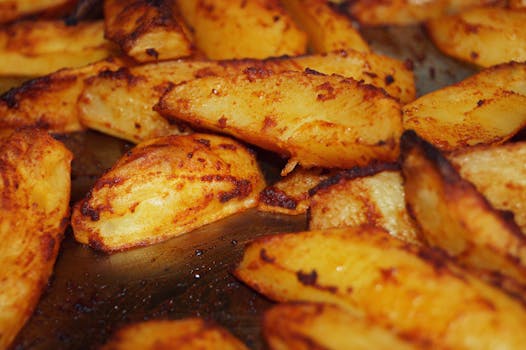 60 g carbs
6.3 g fiber
Potato, baked, peel eaten
Per 1 medium
60 g carbs
6.3 g fiber
Potato, baked, peel eaten
Per 1 medium
-
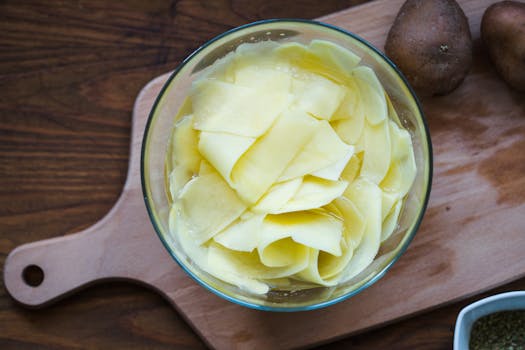 36 g carbs
3.7 g fiber
Potato, boiled, from fresh, peel eaten, no added fat
Per 1 medium
36 g carbs
3.7 g fiber
Potato, boiled, from fresh, peel eaten, no added fat
Per 1 medium
The baked potato shows much more carbohydrate. That is mostly because USDA's "medium" baked potato is a much heavier potato than its "medium" boiled one. Open each card and look at the weight in grams on the food page. Gram for gram, baked and boiled potato are much closer.
This is the main lesson with potatoes: "one medium potato" can mean very different amounts. Baking potatoes vary a lot in size. Weighing your usual potato once on a kitchen scale can be eye-opening. On each food page you can set your own amount, in grams, ounces or USDA's measures.
A potato is usually more than one carb choice. If that term is new, our article What is a carb choice? explains it.
Mashed potatoes and fries
Here is a cup of mashed potato made with milk, and a medium order of fast-food fries:
-
 44 g carbs
3.0 g fiber
Potato, mashed, from fresh, made with milk
Per 1 cup
44 g carbs
3.0 g fiber
Potato, mashed, from fresh, made with milk
Per 1 cup
-
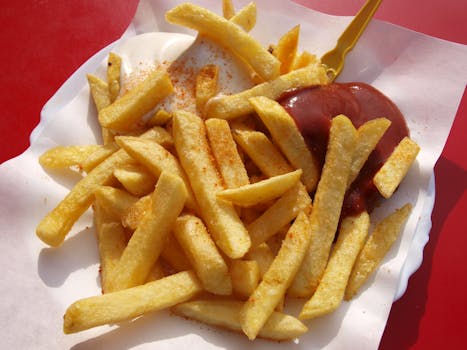 60 g carbs
5.5 g fiber
Potato, french fries, fast food
Per 1 medium fast food order
60 g carbs
5.5 g fiber
Potato, french fries, fast food
Per 1 medium fast food order
Both carry a good deal of carbohydrate. Fries also bring the fat and salt of frying. Tap each card to see the sodium row on the food page.
What large studies found about potatoes and diabetes risk
Two recent analyses of American cohorts looked at whether eating potatoes is linked with developing type 2 diabetes. They matter most for people at risk, rather than for managing diabetes you already have.
- Mousavi and colleagues (2025) followed about 205,000 nurses and health professionals for decades. More French fries was linked with a higher risk of type 2 diabetes. Baked, boiled or mashed potatoes together were not. The link also depended on what replaced the potatoes: swapping potatoes for whole grains was linked with lower risk, while swapping them for white rice was linked with higher risk. A pooled analysis of 13 cohorts in the same paper pointed the same way.
- Djousse and colleagues (2024) pooled seven US cohorts with about 105,500 people. Total potato intake was not linked with type 2 diabetes. Fried potatoes were linked with a modestly higher risk.
Both are observational studies. People who eat a lot of fries may differ from others in many ways, such as what else they eat and where they eat it. So the studies show a link, not that the fries themselves caused diabetes. But the two agree: the concern is mainly with fried potatoes.
How cooking changes the response
The same potato can raise blood glucose by different amounts depending on the variety and how it is cooked.
- Fernandes and colleagues (2005) tested North American potatoes in small groups of healthy adults. The glucose response varied with the variety and cooking method. Boiled red potatoes eaten cold produced a lower response than the same potatoes eaten hot, and instant mashed potatoes produced one of the highest. Russet potatoes cooked the day before, refrigerated and reheated produced a lower response than freshly cooked ones.
- Devlin and colleagues (2021) tested evening meals in 24 adults with type 2 diabetes, managed by diet or metformin. Meals with boiled, roasted, or boiled-then-cooled potato did not raise glucose after the meal more than a basmati rice meal with the same energy. Overnight glucose was lower after all the potato meals than after the rice meal. The cooled potato meal produced a higher insulin response than the rice.
- Huang and colleagues (2017), in a review about pasta, found that pasta meals raised blood glucose less than potato or bread meals in studies that compared them directly.
Cooling cooked potatoes turns some starch into "resistant starch", which the body digests less. That is the idea behind eating them cold or reheated. The studies are small, and they do not change how much carbohydrate is in the portion. The size of the potato still counts.
If you take insulin or glucose-lowering medicine
A change that lowers the rise after a meal, such as cooled potatoes or a smaller portion, can also change how much medicine you need. In a trial of cooled rice in type 1 diabetes (Strozyk and colleagues, 2022), people had more low blood glucose episodes on their usual insulin dose. Our article on rice and diabetes describes it. If you take insulin or a medicine that can cause low blood glucose, talk to your diabetes team before making such a change.
What guidelines say
The American Diabetes Association describes the diabetes plate method: half the plate for nonstarchy vegetables, a quarter for protein and a quarter for carbohydrate foods. Potatoes belong in the carbohydrate quarter, not the vegetable half. The ADA also recommends limiting processed and ultraprocessed foods and keeping sodium under 2,300 mg a day, which bears on fries and packaged potato products.
Neither ADA nor NIDDK says potatoes must go. NIDDK notes that you can still have the foods you enjoy, though perhaps "in smaller portions" or less often.
Potatoes can still have a place
What usually helps is knowing what your potato weighs, how it is cooked, and counting it in your carbohydrate for that meal. The Today page adds up what you log, so you can see what your usual potato adds to the day.
Related reading: Sweet potatoes and diabetes, Pasta and diabetes, Bread and diabetes and Fiber and diabetes.
Your numbers are yours
How much carbohydrate fits in your meals depends on your medicines, your glucose goals and your body. Your doctor, diabetes educator or dietitian sets those numbers, and their advice comes before anything you read here. Your own meter or glucose monitor, checked after your usual meal, can show how potatoes affect you.
Sources
- Mousavi SM, Gu X, Imamura F, et al. Total and specific potato intake and risk of type 2 diabetes: results from three US cohort studies and a substitution meta-analysis of prospective cohorts. BMJ, 2025; 390: e082121. pubmed.ncbi.nlm.nih.gov/40769531 (checked 8 October 2026)
- Djousse L, Zhou X, Lim J, et al. Potato Consumption and Risk of Type 2 Diabetes Mellitus: A Harmonized Analysis of 7 Prospective Cohorts. Journal of Nutrition, 2024; 154(10): 3079–3087. pubmed.ncbi.nlm.nih.gov/39289134 (checked 8 October 2026)
- Fernandes G, Velangi A, Wolever TM. Glycemic index of potatoes commonly consumed in North America. Journal of the American Dietetic Association, 2005; 105(4): 557–562. pubmed.ncbi.nlm.nih.gov/15800557 (checked 8 October 2026)
- Devlin BL, Parr EB, Radford BE, et al. Lower nocturnal blood glucose response to a potato-based mixed evening meal compared to rice in individuals with type 2 diabetes. Clinical Nutrition, 2021; 40(4): 2200–2209. pubmed.ncbi.nlm.nih.gov/33069511 (checked 8 October 2026)
- Huang M, Li J, Ha MA, et al. A systematic review on the relations between pasta consumption and cardio-metabolic risk factors. Nutrition, Metabolism and Cardiovascular Diseases, 2017; 27(11): 939–948. pubmed.ncbi.nlm.nih.gov/28954707 (checked 8 October 2026)
- Strozyk S, Rogowicz-Frontczak A, Pilacinski S, et al. Influence of resistant starch resulting from the cooling of rice on postprandial glycemia in type 1 diabetes. Nutrition & Diabetes, 2022; 12(1): 21. pubmed.ncbi.nlm.nih.gov/35429987 (checked 8 October 2026)
- American Diabetes Association Professional Practice Committee. 5. Facilitating Positive Health Behaviors and Well-being to Improve Health Outcomes: Standards of Care in Diabetes—2026. Diabetes Care, 2026; 49(Suppl 1): S89–S131 (recommendations 5.14 and 5.20; section on eating patterns). pmc.ncbi.nlm.nih.gov/articles/PMC12690188 (checked 8 October 2026)
- NIDDK. Healthy Living with Diabetes (last reviewed October 2023). niddk.nih.gov (checked 8 October 2026)
- USDA FoodData Central: Potato, baked, peel eaten (FNDDS 2709524); Potato, boiled, from fresh, peel eaten, no added fat (FNDDS 2709395); Potato, mashed, from fresh, made with milk (FNDDS 2709496); Potato, french fries, fast food (FNDDS 2709461). fdc.nal.usda.gov (checked 8 October 2026)
- Food figures on this page: USDA FoodData Central, via the DiabeticIndex food database.
This article is general information, not medical advice. Talk to your diabetes care team before changing how you eat or how you take your medicines.