Spaghetti with sauce, macaroni, a pasta salad for a family gathering. Pasta is easy, cheap and loved by children and grandchildren alike. After a diabetes diagnosis, many people put it on the list of foods they think they have lost.
Pasta is a carbohydrate food, so it counts. But research on pasta is more interesting than many people expect. This article goes through what a cup holds, what studies found and what is still unsettled.
What a cup of pasta holds
Here is cooked regular pasta and cooked whole grain pasta, each at one cup as USDA FoodData Central measures it:
-
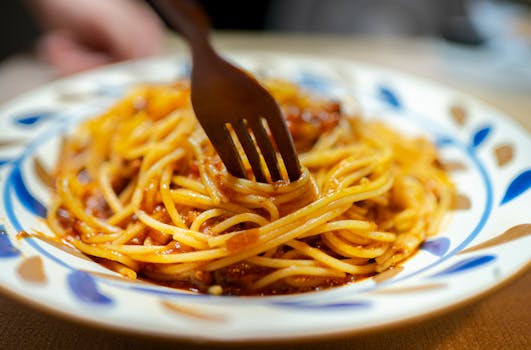 43 g carbs
2.5 g fiber
Pasta, cooked
Per 1 cup, cooked
43 g carbs
2.5 g fiber
Pasta, cooked
Per 1 cup, cooked
-
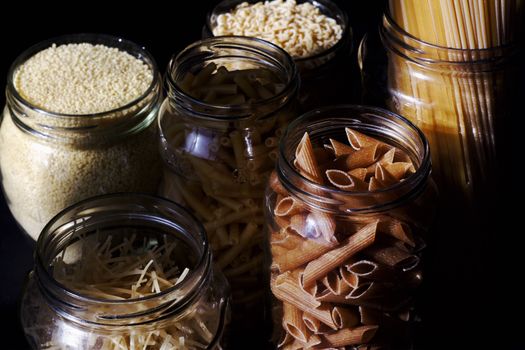 42 g carbs
5.5 g fiber
Pasta, whole grain, cooked
Per 1 cup, cooked
42 g carbs
5.5 g fiber
Pasta, whole grain, cooked
Per 1 cup, cooked
Two things stand out:
- Whole grain pasta is not lower in carbohydrate per cup. The two cards are close.
- Whole grain pasta has more fiber. Tap each card and look at the fiber row on the food page.
A cup of cooked pasta is more than one carb choice. If that term is new, our article What is a carb choice? explains it.
Pasta with sauce
Most pasta is eaten with something on it. Here is a cup of pasta with a home-made tomato and meat sauce:
The sauce adds protein and vegetables, but the cup still carries carbohydrate in the same range as plain pasta, or a little more. The pasta itself is the main source.
The card is per cup, and plates vary. Measuring your usual plate once, with a measuring cup or a kitchen scale, can be eye-opening. On each food page you can set your own amount, in cups, grams or ounces.
What research says about pasta and blood glucose
Pasta has been studied for decades because it behaves a little differently from other starchy foods.
- Jenkins and colleagues (1988), early researchers of the glycemic index, listed pasta among starchy foods that produced relatively flat blood glucose responses, together with legumes, barley and some dense whole grain breads.
- Huang and colleagues (2017) reviewed the studies that compared pasta meals with bread or potato meals. Pasta meals produced a significantly lower rise in blood glucose after eating. But they found no good evidence on what eating pasta does to health over the long term.
- Kristensen and colleagues (2010) tested refined and wholemeal wheat bread and pasta in 16 young healthy adults, with the same amount of carbohydrate in each meal. The pasta meals gave lower glucose responses than the bread meals. Wholemeal and refined versions gave similar responses.
These are tests with the same amount of carbohydrate. A lower rise per gram of carbohydrate does not mean a large plate of pasta acts like a small one. The amount on the plate still matters.
Whole grain or regular
The American Diabetes Association recommends emphasising "minimally processed, nutrient-dense, high-fiber sources of carbohydrate", and favours whole grains over refined grains. Whole grain pasta fits that description because of its fiber. As the Kristensen trial suggests, it may not change the glucose rise after one meal much. Its value is mainly the fiber. Our article on fiber and diabetes covers why fiber matters.
Some people mix regular and whole grain pasta, or add beans or vegetables to the pot. Whether any change suits you depends on your tastes, your family's meals and your care team's advice.
What studies of pasta and health over time say
- Huang and colleagues (2021) followed about 84,500 American women aged 50 to 79 in the Women's Health Initiative. Eating more pasta was not linked with a change in the risk of developing diabetes.
- Chiavaroli and colleagues (2018) pooled 32 trial comparisons in which pasta was part of a low glycemic index eating pattern. Body weight did not go up; it went down slightly compared with higher glycemic index diets. No trial had tested pasta on its own. Several authors have received research support from pasta and other food companies, which the paper declares.
The first is an observational study, which shows a link and not cause. The second looked at pasta inside a whole eating pattern, not pasta alone.
Cooled pasta: an interesting idea, not yet a rule
When cooked starch is cooled, some of it changes into "resistant starch", which the body digests less. You may have read that cooking pasta, chilling it and reheating it lowers its effect on blood glucose.
Rogowicz-Frontczak and colleagues (2026) tested this in 32 adults with type 1 diabetes using insulin pumps. Pasta cooled for 24 hours in the fridge and reheated raised blood glucose less than freshly cooked pasta. In this trial, low blood glucose episodes were no more frequent after the cooled pasta.
The same research group had earlier run a similar trial with cooled rice (Strozyk and colleagues, 2022). There, the cooled rice also raised blood glucose less, but on their usual insulin doses people had more low blood glucose episodes after it. Our article on rice and diabetes describes that trial.
Two small trials, with different results on low blood glucose, are not enough to build a rule on. If you take insulin or a medicine that can cause low blood glucose, a change that lowers the rise after a meal can also change the dose you need. Talk to your diabetes team before relying on cooled pasta to manage your glucose.
Pasta can still have a place
Pasta does not have to disappear from your table. What usually helps is knowing your portion, filling more of the plate with vegetables and protein, and counting pasta in your carbohydrate for that meal. The Today page adds up what you log, so you can see what your usual plate adds to the day.
Related reading: Bread and diabetes, Potatoes and diabetes, Pho and diabetes and Beans and lentils and diabetes.
Your numbers are yours
How much carbohydrate fits in your meals depends on your medicines, your glucose goals and your body. Your doctor, diabetes educator or dietitian sets those numbers, and their advice comes before anything you read here. Your own meter or glucose monitor, checked after your usual plate, can show how pasta affects you.
Sources
- Jenkins DJ, Wolever TM, Jenkins AL. Starchy foods and glycemic index. Diabetes Care, 1988; 11(2): 149–159. pubmed.ncbi.nlm.nih.gov/3383733 (checked 8 October 2026)
- Huang M, Li J, Ha MA, et al. A systematic review on the relations between pasta consumption and cardio-metabolic risk factors. Nutrition, Metabolism and Cardiovascular Diseases, 2017; 27(11): 939–948. pubmed.ncbi.nlm.nih.gov/28954707 (checked 8 October 2026)
- Kristensen M, Jensen MG, Riboldi G, et al. Wholegrain vs. refined wheat bread and pasta. Effect on postprandial glycemia, appetite, and subsequent ad libitum energy intake in young healthy adults. Appetite, 2010; 54(1): 163–169. pubmed.ncbi.nlm.nih.gov/19837118 (checked 8 October 2026)
- Huang M, Lo K, Li J, et al. Pasta meal intake in relation to risks of type 2 diabetes and atherosclerotic cardiovascular disease in postmenopausal women: findings from the Women's Health Initiative. BMJ Nutrition, Prevention & Health, 2021; 4(1): 195–205. pubmed.ncbi.nlm.nih.gov/34308127 (checked 8 October 2026)
- Chiavaroli L, Kendall CWC, Braunstein CR, et al. Effect of pasta in the context of low-glycaemic index dietary patterns on body weight and markers of adiposity: a systematic review and meta-analysis of randomised controlled trials in adults. BMJ Open, 2018; 8(3): e019438. pubmed.ncbi.nlm.nih.gov/29615407 (checked 8 October 2026)
- Rogowicz-Frontczak A, Strozyk S, Pilacinski S, et al. Does Resistant Starch Formed by Cooling Pasta Decrease the Postprandial Glycemic Response in Type 1 Diabetes? A Randomized Single-Blind Crossover Study. Nutrients, 2026; 18(7): 1152. pubmed.ncbi.nlm.nih.gov/41978202 (checked 8 October 2026)
- Strozyk S, Rogowicz-Frontczak A, Pilacinski S, et al. Influence of resistant starch resulting from the cooling of rice on postprandial glycemia in type 1 diabetes. Nutrition & Diabetes, 2022; 12(1): 21. pubmed.ncbi.nlm.nih.gov/35429987 (checked 8 October 2026)
- American Diabetes Association Professional Practice Committee. 5. Facilitating Positive Health Behaviors and Well-being to Improve Health Outcomes: Standards of Care in Diabetes—2026. Diabetes Care, 2026; 49(Suppl 1): S89–S131 (recommendations 5.14 and 5.24). pmc.ncbi.nlm.nih.gov/articles/PMC12690188 (checked 8 October 2026)
- USDA FoodData Central: Pasta, cooked (FNDDS 2708357); Pasta, whole grain, cooked (FNDDS 2708358); Pasta with tomato-based sauce and meat, home recipe (FNDDS 2708838). fdc.nal.usda.gov (checked 8 October 2026)
- Food figures on this page: USDA FoodData Central, via the DiabeticIndex food database.
This article is general information, not medical advice. Talk to your diabetes care team before changing how you eat or how you take your medicines.