Oatmeal is one of the breakfasts people hear about most after a diabetes diagnosis. A friend says it is "good for blood sugar". A packet on the shelf says "heart healthy". Then a glucose meter shows a rise after a bowl, and it is hard to know what to believe.
Both things can be true. Oats are a carbohydrate food, so a bowl raises blood glucose. Oats also contain a kind of fiber that has been studied a great deal. This article goes through what is known, and what is not.
What a cup of oatmeal holds
Here is oatmeal made from regular or quick oats, cooked with water, and the same oatmeal cooked with milk, each at one cup as USDA FoodData Central measures it:
-
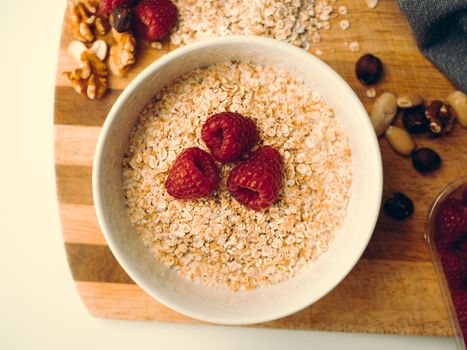 27 g carbs
4.1 g fiber
Oatmeal, regular or quick, made with water, no added fat
Per 1 cup, cooked
27 g carbs
4.1 g fiber
Oatmeal, regular or quick, made with water, no added fat
Per 1 cup, cooked
-
39 g carbs
4.1 g fiber
Oatmeal, regular or quick, made with milk, no added fat
Per 1 cup, cooked
The oats are the same, but the oatmeal made with milk shows more carbohydrate per cup. Milk carries its own natural sugar, lactose, and that is counted too. Open each card and look at the sugars row to see the difference.
A cup of cooked oatmeal is more than one carb choice. If that term is new, our article What is a carb choice? explains it.
Flavored packets
Instant oatmeal comes plain or flavored. Here is plain instant oatmeal and a maple-flavored one, both made with water:
-
 32 g carbs
4.6 g fiber
Oatmeal, instant, plain, made with water, no added fat
Per 1 cup, cooked
32 g carbs
4.6 g fiber
Oatmeal, instant, plain, made with water, no added fat
Per 1 cup, cooked
-
49 g carbs
4.6 g fiber
Oatmeal, instant, maple flavored, no added fat
Per 1 cup, cooked
The flavored one shows clearly more carbohydrate per cup, and most of the extra is sugar. The fiber is about the same. So with packets, the flavor is often what changes the count, not the oats. The label on the packet you buy is the most direct guide to it; our article on reading nutrition labels for carbs shows where to look.
What beta-glucan is
Oats contain beta-glucan, a soluble fiber. In water it becomes thick and gel-like. The idea is that this slows how fast the starch in a meal is digested and absorbed.
Several reviews have looked at what this means for blood glucose:
- Zurbau and colleagues (2021) pooled 103 comparisons from short feeding tests, with 538 people in all. Adding oat beta-glucan to a carbohydrate meal lowered the rise in blood glucose after it. The effect was similar in people with and without diabetes. It grew with the dose, and it depended on the type of beta-glucan: the larger, less broken-down forms worked, the smaller ones did not. Some authors work for a company that runs food tests for industry.
- Shen and colleagues (2016) looked at longer use in type 2 diabetes. They found only four trials, with 350 people. Over three to eight weeks, oat beta-glucan lowered fasting glucose and HbA1c a little. The authors noted that there was little data on longer-term use.
- He and colleagues (2016) compared whole oats and oat bran with beta-glucan taken as an extract. In their review of 18 trials, the whole oats and oat bran were linked with lower HbA1c and fasting glucose in people with type 2 diabetes, but the extracts were not.
Put simply: the effect is real in the studies, it is modest, and it comes from the oats as a food more than from a beta-glucan supplement. The longer-term evidence in diabetes is still thin.
Steel-cut, rolled and instant are not the same
Oats are processed in different ways. Steel-cut oats are chopped grains. Large-flake, or old-fashioned, oats are rolled flat. Quick and instant oats are rolled thinner and often pre-cooked.
A 2015 review by Tosh and Chu gathered the glucose response tests done on oat cereals. Steel-cut and large-flake oats produced a lower blood glucose response than quick-cooking oats and instant oatmeal. The authors explained it this way: smaller pieces, and starch that is more cooked, are digested faster. One of the two authors worked for the Quaker Oats research centre of PepsiCo.
These tests measure the response to the same amount of carbohydrate. They do not change how much carbohydrate is in your bowl. A big bowl of steel-cut oats still holds more carbohydrate than a small one.
What studies of oats and diabetes risk say
Two large analyses looked at whether people who eat oats are less likely to develop type 2 diabetes. These matter most for people at risk, rather than for managing diabetes you already have.
- Hu and colleagues (2020) followed nearly 195,000 American nurses and health professionals. People who ate oatmeal two or more times a week had a lower rate of type 2 diabetes than people who rarely ate it.
- Wehrli and colleagues (2021) pooled eight cohort studies. The highest oat intake was linked with lower type 2 diabetes risk than the lowest. This review was funded by a whole-food supplement company.
These are observational studies. They show a link, not that oats cause the lower risk. People who eat oatmeal often may differ in other ways too.
What guidelines say
The American Diabetes Association recommends emphasising "minimally processed, nutrient-dense, high-fiber sources of carbohydrate", with whole grains among them. NIDDK lists whole grains as part of a healthy meal plan for diabetes. Oats are a whole grain, so they fit that description. Neither guideline names oatmeal as a must, and neither says it can be eaten in any amount.
If you take insulin or glucose-lowering medicine
Changing your breakfast, for example from a flavored packet to plain oats, or from a large bowl to a smaller one, can change your glucose after the meal. If you take insulin or a medicine that can cause low blood glucose, such a change can also change what dose you need. Talk to your diabetes team before making it, and check your glucose as they advise.
Oatmeal can have a place
What usually matters with oatmeal is the size of the bowl, what is cooked or stirred into it, and counting it in your carbohydrate for that meal. The Today page adds up what you log, so you can see what your usual bowl adds to the day.
Related reading: Fiber and diabetes, Bread and diabetes, Milk and diabetes and Rice and diabetes.
Your numbers are yours
How much carbohydrate fits at breakfast depends on your medicines, your glucose goals and your body. Your doctor, diabetes educator or dietitian sets those numbers, and their advice comes before anything you read here. Your own meter or glucose monitor, checked after your usual bowl, can show how oatmeal affects you.
Sources
- Zurbau A, Noronha JC, Khan TA, et al. The effect of oat β-glucan on postprandial blood glucose and insulin responses: a systematic review and meta-analysis. European Journal of Clinical Nutrition, 2021; 75(11): 1540–1554. pubmed.ncbi.nlm.nih.gov/33608654 (checked 8 October 2026)
- Shen XL, Zhao T, Zhou Y, et al. Effect of Oat β-Glucan Intake on Glycaemic Control and Insulin Sensitivity of Diabetic Patients: A Meta-Analysis of Randomized Controlled Trials. Nutrients, 2016; 8(1): 39. pubmed.ncbi.nlm.nih.gov/26771637 (checked 8 October 2026)
- He LX, Zhao J, Huang YS, et al. The difference between oats and beta-glucan extract intake in the management of HbA1c, fasting glucose and insulin sensitivity: a meta-analysis of randomized controlled trials. Food & Function, 2016; 7(3): 1413–1428. pubmed.ncbi.nlm.nih.gov/26840185 (checked 8 October 2026)
- Tosh SM, Chu Y. Systematic review of the effect of processing of whole-grain oat cereals on glycaemic response. British Journal of Nutrition, 2015; 114(8): 1256–1262. pubmed.ncbi.nlm.nih.gov/26330200 (checked 8 October 2026)
- Hu Y, Ding M, Sampson L, et al. Intake of whole grain foods and risk of type 2 diabetes: results from three prospective cohort studies. BMJ, 2020; 370: m2206. pubmed.ncbi.nlm.nih.gov/32641435 (checked 8 October 2026)
- Wehrli F, Taneri PE, Bano A, et al. Oat Intake and Risk of Type 2 Diabetes, Cardiovascular Disease and All-Cause Mortality: A Systematic Review and Meta-Analysis. Nutrients, 2021; 13(8): 2560. pubmed.ncbi.nlm.nih.gov/34444718 (checked 8 October 2026)
- American Diabetes Association Professional Practice Committee. 5. Facilitating Positive Health Behaviors and Well-being to Improve Health Outcomes: Standards of Care in Diabetes—2026. Diabetes Care, 2026; 49(Suppl 1): S89–S131 (recommendations 5.14 and 5.24). pmc.ncbi.nlm.nih.gov/articles/PMC12690188 (checked 8 October 2026)
- NIDDK. Healthy Living with Diabetes (last reviewed October 2023). niddk.nih.gov (checked 8 October 2026)
- USDA FoodData Central: Oatmeal, regular or quick, made with water, no added fat (FNDDS 2708381); Oatmeal, regular or quick, made with milk, no added fat (FNDDS 2708383); Oatmeal, instant, plain, made with water, no added fat (FNDDS 2708387); Oatmeal, instant, maple flavored, no added fat (FNDDS 2708393). fdc.nal.usda.gov (checked 8 October 2026)
- Food figures on this page: USDA FoodData Central, via the DiabeticIndex food database.
This article is general information, not medical advice. Talk to your diabetes care team before changing how you eat or how you take your medicines.